Brunn

The Brünn camp was located in the city of Brno (known in German as Brünn) in the Protectorate of Bohemia and Moravia.
It was located in the SS and Police Technical Academy building in Brno and opened in October 1943 with an initial transport of 251 prisoners, mostly of Polish nationality. Roughly 250 prisoners were held there at its peak in October 1943, which dwindled to 36 prisoners by January 1945. Inmates were confined to tightly spaced metal cots inside locked classrooms with active sentry guards drawn from German police units. The commander was the only official assigned from Auschwitz directly.
The building had originally been a seminary and was uncompleted, so the prisoners were employed on construction tasks to finish the building. They were also employed in the machine shop and smithy, digging foundations for buildings and unloading and sorting laboratory equipment. The subcamp was initially commanded by SS-Hauptscharführer Gerhard Palitzsch and subsequently by SS-Unterscharführer Josef Rieger.

SS-Hauptscharführer Gerhard Palitzsch served as the subcamp’s initial Lagerführer. He was particularly concerned with organisation and discipline, conducting inspections of the prisoner’s accommodation and of their personal hygiene, clothes and personal items. This procedure usually occurred on Sunday mornings, beginning with roll call at 6 am. The prisoners then had to wait on the roll call square until Palitzsch arrived which was usually not until 11 am.
In 1943, Palitzsch was accused of “Race Defilement” and theft and was arrested. He was sent back to Auschwitz, imprisoned in Block 11 and sentenced to death. This sentence was not actually carried out and he was sent to a penal unit instead.
SS-Unterscharführer Rieger took over the command of the camp and he in turn was succeeded by SS-Oberscharführer Walter.

The prisoners were slowly returned to Auschwitz as the construction work was completed, with a large group leaving the subcamp in May 1944 and 50 prisoners remaining. These prisoners worked at printing presses, sorting the typesets. By January 1945, the prisoners had been reduced to 37. These travelled to Austria at the end of the war.
In April 1945, preparations for the evacuation of the subcamp began. Jan Hyla recalls:
“First we had to dismantle all the equipment (machines) which we loaded onto the trucks, which were taken to the train station. There they were loaded onto wagons. When we were finished with this, we were also loaded onto wagons. The journey lasted quite a long time. During the air raids which took place on route, the SS men in such moments, jumped out of their cars and hid in ditches- their weapons trained pointing towards the wagons. We were not allowed to leave the wagons. During the journey a prisoner named Olszewski died. In Brno, he held the position Schreiber (…). on the transport there were about 30 prisoners. The rest had earlier been deported to the camp of Monowice (Monowitz). The evacuation train stopped in Bergen (upper Bavaria at the foot of the Alps), near Traunstein. It was probably on May 1, 1945. For two days we unloaded the train and trucks and delivered (the machines and equipment) to the factory in Bergen (this factory had a foundry and other workshops)…..There was no time for proper segregation and security. This work was not completed. On May 3, 1945, we learned that we would be shot. This order was received by an SS man who came with us from Brno – and who was part of the SS guard in Auschwitz concentration camp. When the prisoners of Germany learned about it, they went to him (I do not remember his name), asking him to at least spare them as Germans…”
The prisoner accommodation consisted of halls on the second floor of a wing of the building, containing metal beds with mattresses and blankets. There were also baths, showers and toilets. The windows were barred.
The meals were of poor quality, provided in small amounts, causing the prisoners to suffer from severe hunger. Former prisoner Józef Kołodziejak recalls:
“The food was very bad consisting of potatoes. Also, we were given a packed lunch of bread and margarine. Where the food came from, I do not know, at least in our accommodation there was no store of food or a kitchen. Meals we received three times a day. Morning coffee and a portion of about 300 grams of bread, soup at noon – mostly water with a little overcooked turnips, turnip or other weeds and in the evening sometimes the soup and a slice of bread. Those who received some soup last – had the opportunity to obtain from the bottom thicker portions of the soup than could be taken at the beginning – who received basically water. Sometimes, but these were rare occasions, there was thicker soup with noodles and peas. After a few days stay in Brno I began to feel hungry and so it was until my departure. The civilian workers working with us did not provide any help and it was not possible to acquire food in any other way (…). One day the foreman from Czechoslovakia, watching us work at the cement mixer, brought a few loaves of bread and each of us took one. We started to move the bread to our living accommodation. When I carried my bread, Palitzsch met me in the hallway, near which on the floor lay a few loaves of bread, which had been taken away from my friends. Palitzsch stopped me and asked where I got the bread. I replied that everyone working on the cement mixer got bread from the supervisor. He let me keep the bread because I had told the truth. The rest of the prisoners lied as to where they had got the bread from and their bread was taken.”
Working groups were established for carpenters, masons, glaziers, locksmiths, painters and electricians. There were also teams of unskilled laborers who worked in the grounds around the academy building.
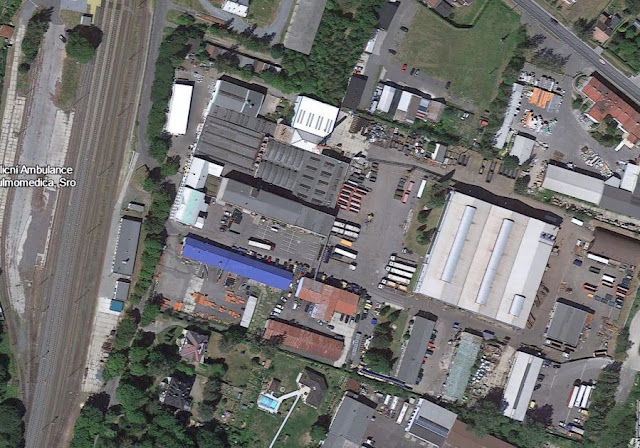
The former building of the SS and Police Technical Academy is currently occupied by the Biskupská Gymnasium Brno (Episcopal High School in Brno) with another part of the building accommodating a radio station.


Comments
Post a Comment