Aschersleben (men's camp)


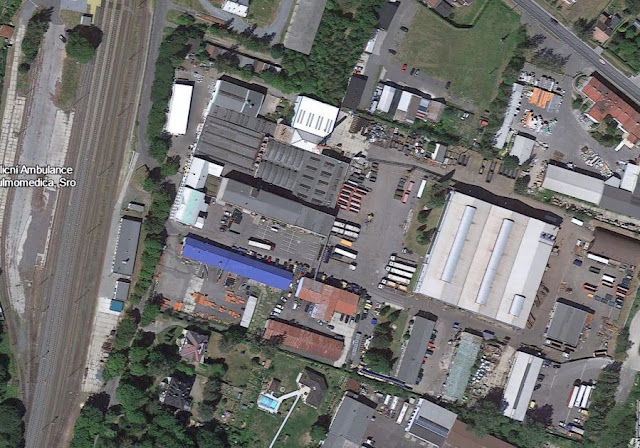
Junkers Flugzeug- und Motorenwerk AG opened another plant in May 1935, in the town of Aschersleben, located on what is now Walter-Kersten-Straße, to the NW of the city centre. In immediate proximity, to the south of the site of the plant, is a freight depot, which is now reduced by half of its former area.
Junkers had used foreign forced labour at its various plants from the start of the war, employing them on the manufacture of aircraft components, particularly fuselages for the Junkers JU88.

At Aschersleben, a subcamp was built just NW of the freight depot for this purpose. It was given the code name ‘Maus’ and was one of around a dozen such subcamps serving the plant. Alongside manufacture of the Junkers JU88, prisoners also worked on the Heinkel HE 162, for which the factory had been converted to facilitate its production. Another aircraft produced at the plant was the Volksjager, a single-engine jet fighter that was, in essence, the Nazis last attempt to change the course of the war. It was flown by the ‘Fliegende Hitler-Jugend’ (“Flying Hitler-Youth”) but it was still under development and was almost unable to be steered or landed properly.
The commander of Aschersleben was an SS-Hauptscharführer named Reuter. There were 39 SS men working as guards in November 1944, but as the numbers of prisoners increased, so too did the numbers of guards. When the female subcamp was constructed, female SS guards were brought in. This resulted in a total of 73 SS men and 11 SS women by March 1945. In 1975, investigations by the Central Office in Ludwigsburg regarding a death march from Aschersleben concluded without any prosecutions.

The subcamp was basically an annex to Hall IV of the factory. There was a kitchen and washrooms on the ground floor while the upper floor contained the sleeping quarters for the prisoners as well as an improvised, fairly large, infirmary. It was surrounded by a high electrified barbed-wire fence and watchtowers, which probably surrounded the working area in Hall IV as well.
This subcamp was for male prisoners, but in January 1945, another subcamp was established for female prisoners.
An advance group of 177 prisoners arrived on 14th August 1944 from Buchenwald. However, further transports brought the total number of prisoners to 411 by early September 1944. Most of them were political prisoners from the USSR, Poland, France, Czechoslovakia, Germany, the Netherlands, Italy, Yugoslavia, Croatia, Spain, Greece, and Albania, but some of them were classified ‘work shy’, ‘asocial’ or ‘career criminal’. Some of them had already been incarcerated in Dachau or Saschsenhausen before being transferred to Buchenwald. Other prisoners were regularly brought to Aschersleben from the Schönebeck subcamp (‘Julius’). By December 1944, the camp held 653 prisoners, but this total was reduced a month later when the SS transferred 194 to the Langenstein-Zwieberge subcamp.
The prisoners were classed as unskilled, meaning that the firm had to pay the SS four Reichsmarks per prisoner per workday. This, in the opinion of the plant management, limited their usefulness, so in September 1944, the plant requested the replacement of 50-60 prisoners with skilled labour. This request was refused, so prisoners were subsequently trained on site. By October, some of the prisoners in the camp had been classed as ‘semi-skilled’ and were used on the assembly of fuselages, lower-shells and upper-shells. The prisoners worked 12-hour shifts night and day with no days off, although Sunday work was more relaxed. They also worked on other tasks outside the plant, such as constructing air raid shelters and disabling unexploded bombs.
Raymond Smelten, a Belgian physician, was appointed by the SS as ‘prisoner-doctor’, assisted by a French medical student named Harry Girardot. An SS medic and Oberscharführer, Max Schönherr, supervised them and there was also an unnamed company doctor from the Junkers works and a contract physician, named Dr Echtle, available. However, seriously ill prisoners were regularly transferred back to Buchenwald. Nine deaths from Aschersleben are on record, mostly from pulmonary and heart conditions. Other illnesses recorded among the prisoners include typhoid, cystitis, nephritis, tuberculosis and inflammation of the lungs. Dead prisoners were cremated in Quedlinburg.
By the time of its evacuation, conducted between 6th and 11th April 1945, the camp held 400 male prisoners.
Records show at least eight escape attempts. One of these, by Polish prisoner Zygmunt Kazmierczak, resulting in him being shot by an SS guard.
For further information, see the Buchenwald Subcamp Portal.


Comments
Post a Comment